In North America, the standard pallet size is 48 inches x 40 inches (1219 mm x 1016 mm). Commonly referred to as the GMA pallet, this dimension is the critical starting point if you are looking to buy plastic pallets or source wooden options for your supply chain. This specific footprint accounts for over 30% of all pallets produced in the United States and is designed to fit seamlessly into standard 53-foot semi-trailers. As a procurement officer, knowing these specs is the first step before contacting a wholesale pallet supplier.
Key Takeaways
- The Standard: The 48″ x 40″ GMA pallet is the dominant size for US logistics.
- Global Variations: Exporting to Europe or Asia requires adherence to ISO standards (e.g., 1200mm x 800mm Euro pallets) to prevent rejection at destination ports.
- Load Physics: Dimensions are useless without knowing the load capacity. You must distinguish between Static, Dynamic, and Racking loads.
- Material: Plastic pallets offer precise dimensions for automation, whereas wood pallets have slight variances due to moisture and repair history.
- Customization: Industries like Automotive and Chemical often require non-standard footprints (e.g., 48″ x 45″) for specific container optimization.
What Is the Standard Pallet Size?
When you ask “how big is a pallet” in a US domestic context, you are almost always discussing the GMA pallet.
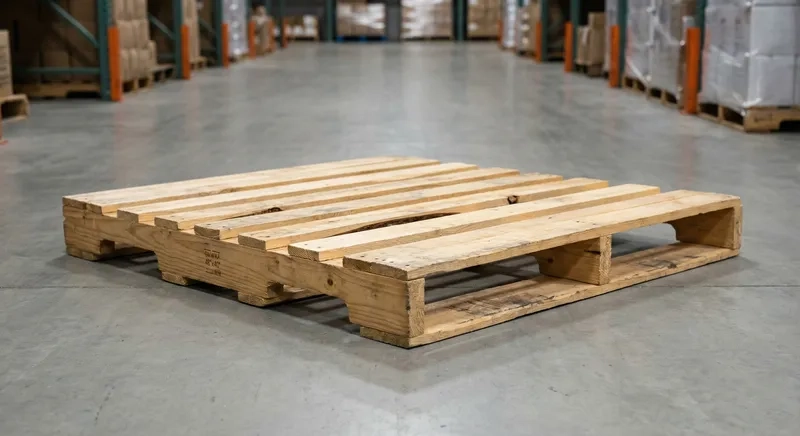
The GMA (Grocery Manufacturers Association) pallet measures 48 inches long by 40 inches wide. It features a 4-way entry design, allowing forklifts and pallet jacks to access the pallet from all four sides, which is critical for rapid loading and unloading in high-throughput distribution centers.
Why 48″ x 40″ Dominates the Supply Chain
This specific dimension wasn’t chosen at random. It is mathematically optimized for the 53-foot dry van trailer, which is the backbone of American freight. The interior width of these trailers allows for two distinct loading configurations:
- Straight Loading: Placing pallets side-by-side with the 48″ side facing forward.
- Pinwheeling: Alternating the orientation of the pallets to maximize floor space.

By utilizing the 48×40 standard, you can fit approximately 26 single-stacked pallets or 52 double-stacked pallets in a standard trailer. Any deviation from this size—even by an inch—can result in “dead air” (wasted space) inside the truck, meaning you are shipping air rather than product. For high-volume logistics, maximizing cube utilization is the quickest way to lower your per-unit shipping cost. When you analyze bulk pallet pricing, always factor in this freight efficiency. Choosing the correct, standardized dimension ensures you aren’t just paying for the pallet, but also optimizing your entire logistics budget.
International Pallet Sizes
If your supply chain extends beyond domestic borders, relying solely on the GMA standard will cause bottlenecks. International logistics rely on the ISO 6780 standard, which defines six pallet dimensions used globally. Using the wrong size when exporting can result in your cargo being repalletized at the port of entry—a massive hidden cost.
Global Pallet Dimension Chart
| Region / Standard | Dimensions (Inches) | Dimensions (Millimeters) | Primary Applications |
| North America (GMA) | 48″ x 40″ | 1219mm x 1016mm | Grocery, General Logistics, Retail |
| Europe (Euro Pallet) | 47.24″ x 31.5″ | 1200mm x 800mm | Retail, FMCG, Intra-European Trade |
| Asia | 43.30″ x 43.30″ | 1100mm x 1100mm | Chemical, Manufacturing, Export |
| Australia | 45.9″ x 45.9″ | 1165mm x 1165mm | General Warehousing (Fits Australian Rail) |
| North America/Europe | 42″ x 42″ | 1067mm x 1067mm | Telecommunications, Paint |
| Global (ISO) | 48″ x 32″ | 1219mm x 813mm | Retail, Beverages, Doorways |
ISPM-15 Compliance
Beyond dimensions, you must consider the material. If you are shipping goods internationally on wooden pallets, they must be heat-treated and stamped according to ISPM-15 standards to prevent the spread of pests. Non-compliance leads to customs quarantine.
This is a primary reason why many Exporters switch to Plastic Pallets. Plastic is naturally exempt from ISPM-15 regulations, immune to moisture, and does not require heat treatment certification, ensuring your goods clear customs faster.
Pallet Height, Weight, and Load Capacity
While length and width determine if a pallet fits in a truck, the height, weight, and load capacity determine if it will survive the journey. Ignoring these “Z-axis” specs is a common cause of warehouse accidents and product damage.
1. Standard Pallet Height
The standard height for a wooden GMA pallet is approximately 6 inches (15 cm).
In the world of plastic pallets, low-profile “nestable” options can be as low as 5.5 inches, while heavy-duty rackable pallets may reach 6.5 inches to accommodate steel reinforcement. When calculating stack heights for warehousing, those fractions of an inch add up.
2. Pallet Weight
- Wooden Pallets: Typically weigh between 30 to 48 lbs (13-22 kg). This weight fluctuates significantly based on moisture content (a wet pallet is heavier) and wood density.
- Plastic Pallets: Offer consistent tare weights. A light-duty export pallet can weigh as little as 12 lbs, while a heavy-duty reusable pallet averages 35-50 lbs.
- Why it matters: If you are shipping via air freight, every pound counts. Switching to lighter plastic export pallets can save thousands in annual freight charges.
3. Load Capacity Ratings
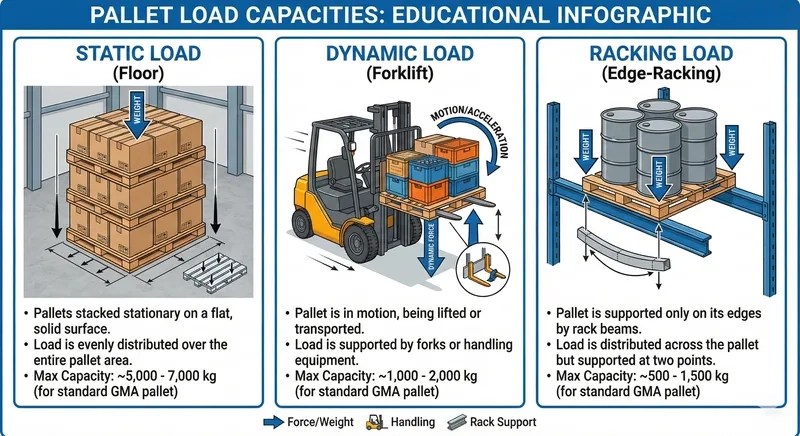
- Static Load (Floor Load): The maximum weight a pallet can hold when resting on a solid, flat floor. Standard GMA: ~10,000 lbs.
- Dynamic Load (Forklift Load): The maximum weight the pallet can support when being lifted by a forklift or jack. Standard GMA: ~4,600 lbs (approx. 2000 kg).
- Racking Load (Edge-Racking): The most critical metric. This is the weight the pallet can support when spanning the open beam of a warehouse racking system. Not all pallets are rackable. Standard GMA Wood: ~2,500 lbs.
Tip: If you are implementing an Automated Storage and Retrieval System (AS/RS), standard wooden pallet deflection ratings may not be strict enough. High-performance plastic pallets are often required to prevent system jams.
Industry-Specific Pallet Sizes
Standard sizes maximize volume, but specialized industries prioritize product fit and stability. Using a standard 48×40 for a chemical drum that doesn’t fit securely creates safety risks. Here are common non-standard sizes tailored for specific sectors:
The Chemical & Beverage Industry
Common Size: 48″ x 48″ (1219mm x 1219mm)
This square design is ideal for transporting 55-gallon drums. Four drums fit perfectly on a 48×48 square without overhang, providing superior stability compared to the 48×40. This size is also prevalent in the beverage industry for shipping heavy liquids where balance is key.
The Automotive Industry
Common Size: 48″ x 45″ (1219mm x 1143mm)
Automotive supply chains are highly integrated. The 48×45 footprint is designed to fit specific automotive returnable containers (Gaylords) and fits efficiently into the dedicated logistics loops used by major car manufacturers (OEMs) and Tier 1 suppliers.
Note: If you are sourcing pallets for long or irregular items that simply won’t fit a standard footprint, the issue might be your storage system, not the pallet. Compare your options in our article: Cantilever Racking vs. Pallet Racking.
Retail & Narrow Aisle Operations
Common Size: 48″ x 20″ (1219mm x 508mm)
Often called “half-pallets,” these are used for in-store merchandising. They allow retailers to move product directly from the truck to the sales floor aisle without restocking shelves manually. They are small enough to navigate through narrow customer-facing doorways.
Dairy Industry
Common Size: 40″ x 40″ (1016mm x 1016mm)
Square and compact, specifically designed for stacking milk crates efficiently.
Need a specific size not listed here?
If your production line handles unique components that don’t align with these dimensions, you don’t have to force a fit. As a Pallet Racking manufacturer, we provide Custom Mold Manufacturing to build pallets that match your exact product footprint.
Material Impact: Wood vs. Plastic vs. Metal
The material you choose dictates the consistency of the pallet’s dimensions. In a manual warehouse, a 0.5-inch variance might be annoying. In an automated supply chain, it causes system failures.
Wood
Wooden pallets are cost-effective upfront. However, wood is an organic material. It warps, shrinks, and swells based on humidity.
- Dimensional Stability: Low. A “48-inch” wooden pallet might actually be 47.5″ or 48.5″ depending on repair history and wood quality.
- Durability: Susceptible to splintering and fastener failure (nails popping out), which can damage packaging.
Plastic
Plastic pallets are molded, meaning the dimensions are exact down to the millimeter. When you source from a reputable plastic pallet manufacturer, you gain access to consistent, heavy-duty pallets that don’t jam your automated systems.
- Dimensional Stability: High. Perfect for conveyor systems and robotic palletizers that require precise sensors.
- Cleanliness: Non-porous, easy to sanitize, and free of dust or contaminants.
- TCO Analysis: While the initial price is higher, plastic pallets last 10x longer (often 250+ trips vs. 5-10 trips for wood), offering a lower Total Cost of Ownership over time.
Metal
Used primarily for extreme loads or high-heat environments.
- Dimensional Stability: Excellent, but heavy and expensive.
The material you choose dictates the consistency of the pallet’s dimensions and its long-term value. In a manual warehouse, a 0.5-inch variance might be a minor annoyance. In an automated supply chain (AS/RS), it causes system failures and expensive downtime.
Below is a direct comparison of the three primary pallet materials to help you calculate the Total Cost of Ownership (TCO).
Pallet Material Comparison Chart
| Feature | Wood Pallets | Plastic Pallets | Metal Pallets |
| Initial Cost | Low ($) | Medium/High ($$-$$$) | Very High ($$$$) |
| Lifespan (Trips) | Short (5-10 trips) | Long (250+ trips) | Very Long (Lifetime) |
| Dimensional Consistency | Variable (Warps/swells with moisture) | Precise (Molded to exact spec) | Precise (Welded/Riveted) |
| Hygiene & Safety | Porous; Risk of mold, nails, and splinters. | Non-porous; Easy to sanitize; No nails. | Easy to clean; No nails; Heavy/Sharp edges. |
| ISPM-15 Export | Requires Heat Treatment & Stamp | Exempt (Hassle-free export) | Exempt |
| Weight (Tare) | Variable (Absorbs water, heavier) | Constant (Lighter, saves freight) | Heavy |
| Best Application | One-way shipping; Open-loop supply chains. | Closed-loop systems; Food/Pharma; Automation. | Heavy industrial loads; Extreme heat/cold. |
Which material fits your budget? Don’t just look at the purchase price.
- Wood is the “cheap right now” option but carries hidden costs in product damage and disposal fees.
- Plastic is the “investment” option. Switching to high-quality plastic pallets yields a positive ROI within 12-18 months due to durability and freight savings.

Ready to upgrade your warehouse infrastructure? Browse our full range of storage products to find the system that matches your pallet specifications.
How to Measure a Pallet Correctly
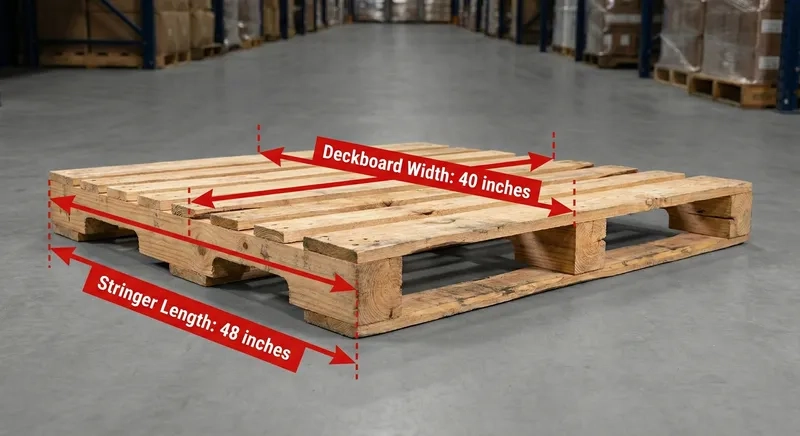
It sounds simple, but inconsistency in measuring leads to procurement errors. When requesting a quote, ensure you are measuring the Stringer Length vs. Deckboard Width.
- Stringer Length (The First Number): In a 48×40 pallet, 48″ is the stringer length. This is the length of the solid board (or stringer) that runs the full length of the pallet.
- Deckboard Width (The Second Number): 40″ is the width of the deck boards attached to the stringers.
Pro Tip: In 4-way pallets, you can enter from any side, but the load bearing strength is usually dictated by the stringers. Always specify “Length x Width” clearly to your supplier to avoid receiving a pallet that fits your truck but not your racking depth.
Frequently Asked Questions
How wide is a standard pallet?
How many boxes fit on a 48×40 pallet?
Can I fit Euro pallets into a US standard container?
What is the maximum height I can stack a pallet?
How big is a skid vs. a pallet?
Conclusion
“how big is a pallet” is more than just memorizing the 48″ x 40″ GMA standard. It is about aligning your logistics infrastructure with the physical realities of your products. Whether you are moving FMCG goods across North America or exporting precision parts to Asia, the dimensions of your pallet dictate the efficiency of your entire supply chain.
If your current pallets are causing product damage, failing in your automated systems, or costing you too much in freight due to poor weight ratios, it is time to re-evaluate your specifications.
Whether you need a competitive request a quote for GMA-compliant 48×40 options or a completely custom pallet solution for heavy industrial loads, our engineering team is ready to assist. As a direct pallet factory, we eliminate the middleman to provide you with the best value.
Contact us today for a competitive quote and a free supply chain audit to see how the right pallet can save you money.