When you evaluate your facility’s layout and operational flow, understanding the specific applications of selective pallet racking vs drive-in racking is an essential step. Your storage configuration directly impacts inventory turnover rates, forklift maneuverability, and overall profitability. Both pallet racking systems offer distinct structural and logistical advantages, but implementing the wrong pallet racking system can lead to severe operational bottlenecks and wasted floor space.
As a professional warehouse manager, you need practical, data-backed insights to make this structural decision. Below is a comprehensive breakdown of these two prominent high-density storage systems, analyzing their functionality, advantages, disadvantages, and ideal use cases.
✓ Key Takeaways
- Selective pallet racking provides 100% SKU accessibility, making it the optimal choice for operations managing a high variety of diverse products.
- Drive-in racking maximizes storage density by eliminating conventional forklift aisles, serving as the perfect solution for large volumes of identical SKUs.
- Your final choice depends heavily on whether your inventory strictly requires a First-In, First-Out (FIFO) or a Last-In, First-Out (LIFO) management strategy.
- Upfront equipment costs differ significantly, with selective pallet racking requiring lower initial investment but occupying more square footage per pallet position.
- Spieth engineers and manufactures both selective pallet racking and drive-in racking to meet stringent international warehouse safety and structural durability standards.
What is Selective Pallet Racking?
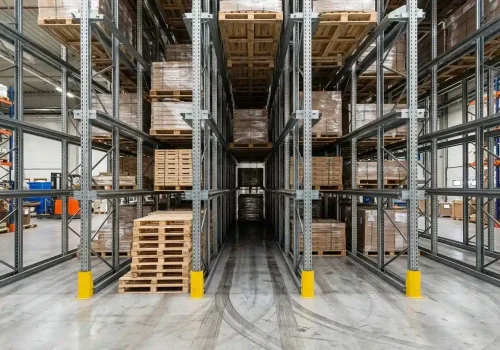
Selective pallet racking is the most common and versatile storage system used in modern warehousing. Selective pallet racking allows forklift operators to “select” and access any specific pallet without having to move other pallets out of the way. Selective pallet racking typically consists of upright frames and horizontal load beams configured in single or double deep rows, separated by standard aisles.

The Pros of Selective Pallet Racking
1. Complete Inventory Accessibility
The primary advantage of selective pallet racking is total accessibility. You have immediate, unimpeded access to every single pallet stored in your warehouse. If your business handles thousands of different Stock Keeping Units (SKUs) and fulfills multiple varied orders daily, selective pallet racking ensures your pickers never waste time digging through inventory to find the correct product.
2. Supports First-In, First-Out (FIFO)
Because you can access any pallet at any time, selective pallet racking naturally supports FIFO inventory rotation. This is critical if you handle perishable goods, pharmaceuticals, or products with expiration dates. You can easily rotate older stock out before newer stock, minimizing spoilage and obsolescence.
3. Lower Initial Investment Costs
Compared to highly engineered systems, selective pallet racking typically requires a lower initial capital expenditure. The design is straightforward, the components are standardized, and the installation process is relatively fast. For new facilities or expanding businesses monitoring their upfront budgets, selective pallet racking provides immediate, cost-effective storage volume.
4. High Adaptability and Scalability
You can easily reconfigure selective pallet racking to accommodate changing operational needs. If your pallet heights change, you can adjust the horizontal load beams quickly. You can also dismantle, relocate, or expand selective pallet racking with minimal disruption to your daily operations.
The Cons of Selective Pallet Racking
1. Lower Storage Density
The major drawback of selective pallet racking is poor space utilization. Because every row requires an adjacent forklift aisle for access, up to 50% or more of your total warehouse floor space may be dedicated solely to aisles rather than actual product storage.
2. Higher Storage Costs Per Pallet
While the initial equipment cost is lower, the long-term cost per pallet position can be higher when you factor in the land and building costs. Heating, cooling, and maintaining a larger facility simply to accommodate forklift aisles increases your overhead expenses.
What is Drive-In Racking?
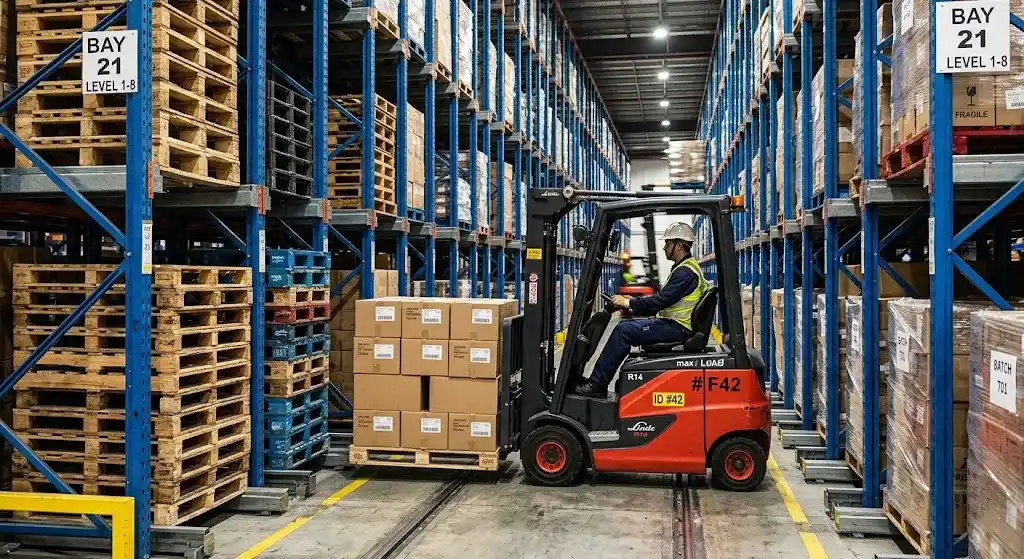
Drive-in racking is a high-density storage system designed to maximize cubic space utilization. Instead of individual load beams, drive-in racking uses horizontal rails that support the pallets. Forklifts literally “drive in” to the storage bays to deposit or retrieve pallets. By eliminating standard aisles between the racks, drive-in racking compresses storage into a solid block of product.
The Pros of Drive-In Racking
1. Maximum Storage Density
Drive-in racking provides exceptional storage density. By removing the need for operating aisles, you can store up to 75% more pallets in the same footprint compared to selective pallet racking. This makes drive-in racking highly advantageous when floor space is at a premium or expansion is physically impossible.
2. Ideal for Cold Storage and Freezers
Cold storage and industrial freezer space is the most expensive real estate in the logistics industry. Because drive-in racking condenses your storage, you minimize the amount of air you need to continuously cool. This drastically reduces energy consumption and maximizes the return on investment for temperature-controlled facilities.
3. Excellent for High-Volume, Low-SKU
If your manufacturing facility produces massive quantities of a single product line, drive-in racking is exceptionally efficient. You can fill an entire bay with the same SKU, ensuring that space is utilized solely for bulk storage rather than selective picking.
The Cons of Drive-In Racking
1. Restricted to LIFO Management
Because forklifts load pallets into a single lane from back to front, the last pallet deposited must be the first one removed. This Last-In, First-Out (LIFO) system makes drive-in racking unsuitable for perishable goods or any inventory that requires strict date-code rotation.
2. Zero Selective Accessibility
You cannot access the pallets at the back of a drive-in lane without first removing all the pallets in front of them. This creates severe logistical problems if an operator accidentally stores the wrong SKU in the back of a deep lane.
3. Higher Risk of Forklift Damage
Because operators must drive their material handling equipment directly inside the drive-in racking structure, the risk of accidental collision with the upright frames is significantly higher. This necessitates robust guard rails, specialized forklift training, and more frequent structural safety inspections.
Selective Pallet Racking vs Drive-In Racking
How to Choose the Right System for Your Facility
Selecting between selective pallet racking vs drive-in racking ultimately comes down to analyzing your specific inventory data. You must evaluate your SKU count against your total pallet volume.
If you carry 5,000 different items but only hold two or three pallets of each item, you absolutely require selective pallet racking. Attempting to use a high-density system for highly varied inventory will cause your fulfillment rates to plummet due to constant pallet shuffling. Conversely, if you manufacture a single type of bottled water and hold 500 pallets of it at a time, using selective pallet racking would be a massive waste of expensive floor space, making drive-in racking the clear choice.
Furthermore, consider your inventory turnover speed. Fast-moving consumer goods that require rapid dispatch benefit from the quick access provided by selective pallet racking. Bulk materials intended for long-term seasonal storage are better suited for drive-in racking.
Exploring Next-Level Warehouse Automation
Once you have determined the correct static racking system for your current needs, you might find that your operation is outgrowing traditional forklift-driven processes entirely. If you are struggling with labor shortages or require even faster throughput, transitioning from conventional pallet racking to automated storage and retrieval systems (AS/RS) or radio shuttle racking could be the next logical step to investigate for your facility’s future expansion.
Secure Your Supply Chain with Spieth Racking Solutions
Optimizing your facility’s layout is not just about buying steel; it is about engineering a logistical flow that drives your business forward. Whether your data points toward the complete accessibility of selective pallet racking or the footprint optimization of drive-in racking, you need a manufacturing partner who understands structural integrity and industrial safety.
As a premier manufacturer of industrial storage solutions, Spieth provides custom-engineered systems designed precisely for your operational demands. We handle the entire process from structural blueprinting to final manufacturing, ensuring your warehouse operates safely and efficiently.
Frequently Asked Questions
What is the difference between selective pallet racking and drive-in racking?
The main difference is accessibility and density. Selective pallet racking allows you to access any individual pallet at any time, but requires extensive aisle space. Drive-in racking eliminates aisles to store pallets densely in deep lanes, but you can only access the front pallet in each lane.
When should you use drive-in racking?
You should use drive-in racking when you have limited warehouse space, high volumes of identical SKUs, and inventory that does not expire quickly. Drive-in racking is particularly cost-effective in cold storage and freezer environments where minimizing the physical footprint reduces energy costs.
Is selective pallet racking cheaper than drive-in racking?
Yes, in terms of initial equipment costs. Selective pallet racking uses fewer specialized components and simpler engineering, making the upfront purchase price lower. However, selective pallet racking requires a larger building footprint per pallet stored, which can increase long-term facility leasing costs.
Does drive-in racking use FIFO or LIFO?
Drive-in racking operates strictly on a Last-In, First-Out (LIFO) inventory management system. Because pallets are loaded into a single lane, the last pallet placed into the drive-in racking blocks the older pallets behind it and must be the first one removed by the forklift operator.
Can I mix selective pallet racking and drive-in racking in the same warehouse?
Yes, utilizing a hybrid layout is a highly recommended strategy. You can install drive-in racking for your bulk, fast-moving items while utilizing selective pallet racking for picking operations and diverse, low-volume SKUs within the same facility.