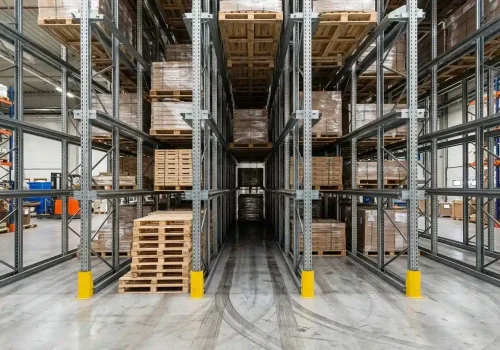
If you need to store large volumes of palletized goods with fewer aisles and higher cube utilization, drive-in racking is one of the most practical warehouse storage solutions available.
It is widely used in cold storage, food and beverage, manufacturing, and other operations where you handle many pallets of the same SKU.
The main question is not just what drive-in racking is. The real question is whether your warehouse, pallet profile, forklift fleet, and operating method are suitable for it. That is where structure design, forklift compatibility, and safety standards matter.
At Spieth, we manufacture warehouse racking systems for industrial storage applications, and in practice, drive-in systems perform well only when design and operation are aligned from the start.
That is why this guide focuses on the three most important areas: structure, forklift requirements, and operational safety.
What Is Drive-In Racking?
Drive-in racking is a type of high-density pallet racking system where forklifts drive directly into storage lanes to place or retrieve pallets. Instead of storing pallets on standard beams like selective pallet racking, drive-in racks use side support rails. Pallets are stored several positions deep on both sides of a lane.
This design reduces the number of aisles in your warehouse and increases storage density. In many facilities, that means more pallets stored in the same footprint.
How Drive-In Racking Works
You place pallets into a lane one position behind another. Because of this lane-based storage arrangement, the last pallet loaded is usually the first pallet removed. That means drive-in racking is commonly used in LIFO warehouse storage environments.
If you are comparing density-focused systems, you may also want to review push back racking or shuttle racking in a separate evaluation, since each system supports a different inventory flow and handling pattern.
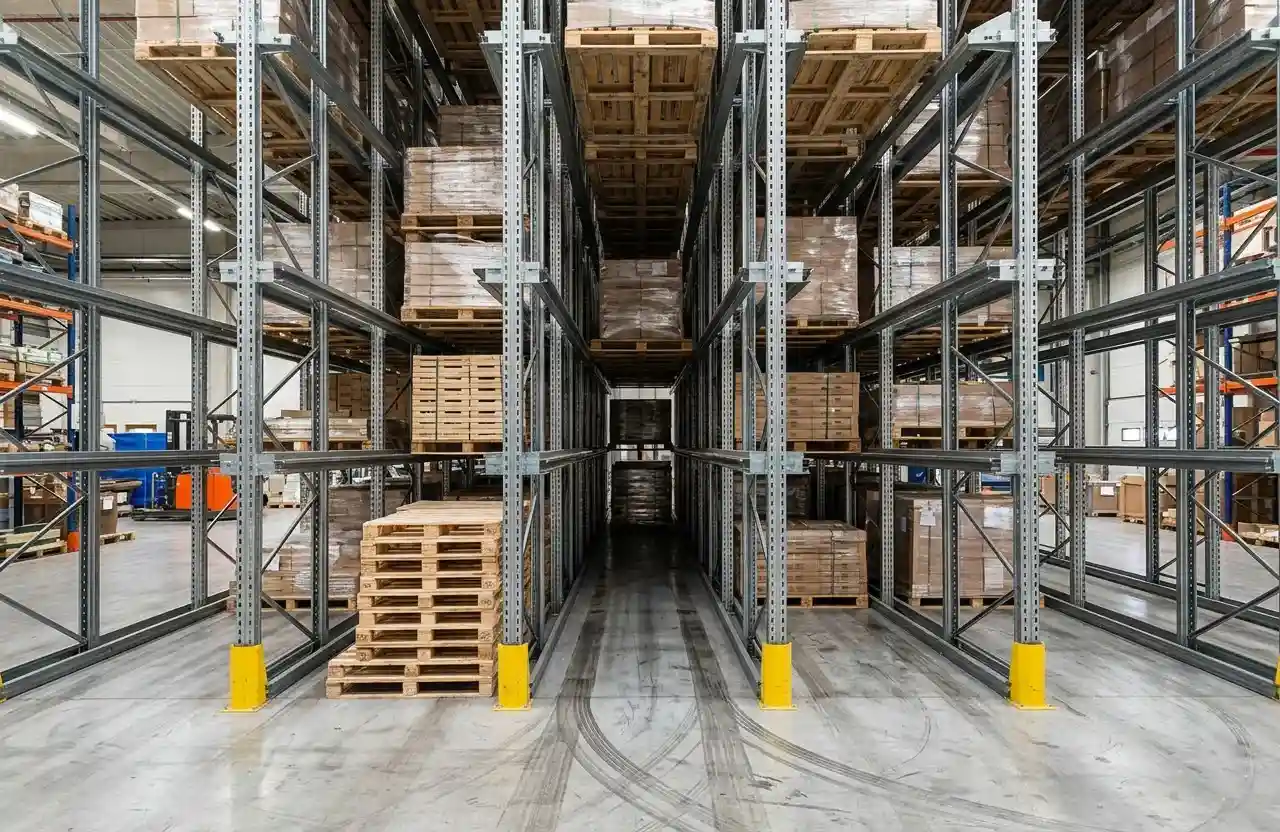
Key Components of a Drive-In Racking Structure
A drive-in racking structure must do more than hold pallets. It must also withstand repeated forklift entry, concentrated loads, and the demands of deep-lane storage. For that reason, every component matters.
Upright frames
Function: Vertical load-bearing structure
Why It Matters: Supports rack height and bay stability
Pallet rails
Function: Side rails that carry pallet loads
Why It Matters: Essential for deep-lane pallet placement
Top beams
Function: Connect uprights at the top
Why It Matters: Improve rigidity and lane alignment
Bracing
Function: Horizontal and vertical reinforcement
Why It Matters: Helps resist sway and impact stress
Entry guides
Function: Guide forklift entry into lanes
Why It Matters: Reduces accidental contact
Pallet stops
Function: Control pallet depth
Why It Matters: Prevents overtravel and product damage
Baseplates and anchors
Function: Connect rack to floor
Why It Matters: Critical for stability and safety
Upright protectors
Function: Protect front uprights
Why It Matters: Reduce damage from forklift strikes
Upright Frames
The upright frame is the backbone of the entire system. It carries vertical loads and supports the lane assembly. In a drive-in rack, uprights are exposed to a higher chance of impact than in many other rack types because forklifts enter the structure during normal operation.
For that reason, upright thickness, steel quality, frame geometry, and anchor integrity should be selected based on actual working conditions, not just nominal pallet weight.
Pallet Rails
Pallet rails are one of the most critical components in a drive-in pallet racking system. They run along both sides of the lane and support pallet edges as the forklift places each load into position.
Your pallet specification must match the rail design. If pallet dimensions vary too much, or if pallet quality is poor, you increase the risk of unstable loading and rail contact damage.
Top Beams and Bracing
Because drive-in racks are deep and aisle-light, they depend heavily on top beams and bracing systems for structural stability. These elements help keep the lanes aligned and resist torsion during loading and unloading.
This is especially important when you use high-bay layouts or install systems in cold storage, where steel performance and tolerance control become more important.
Entry Guides and Protectors
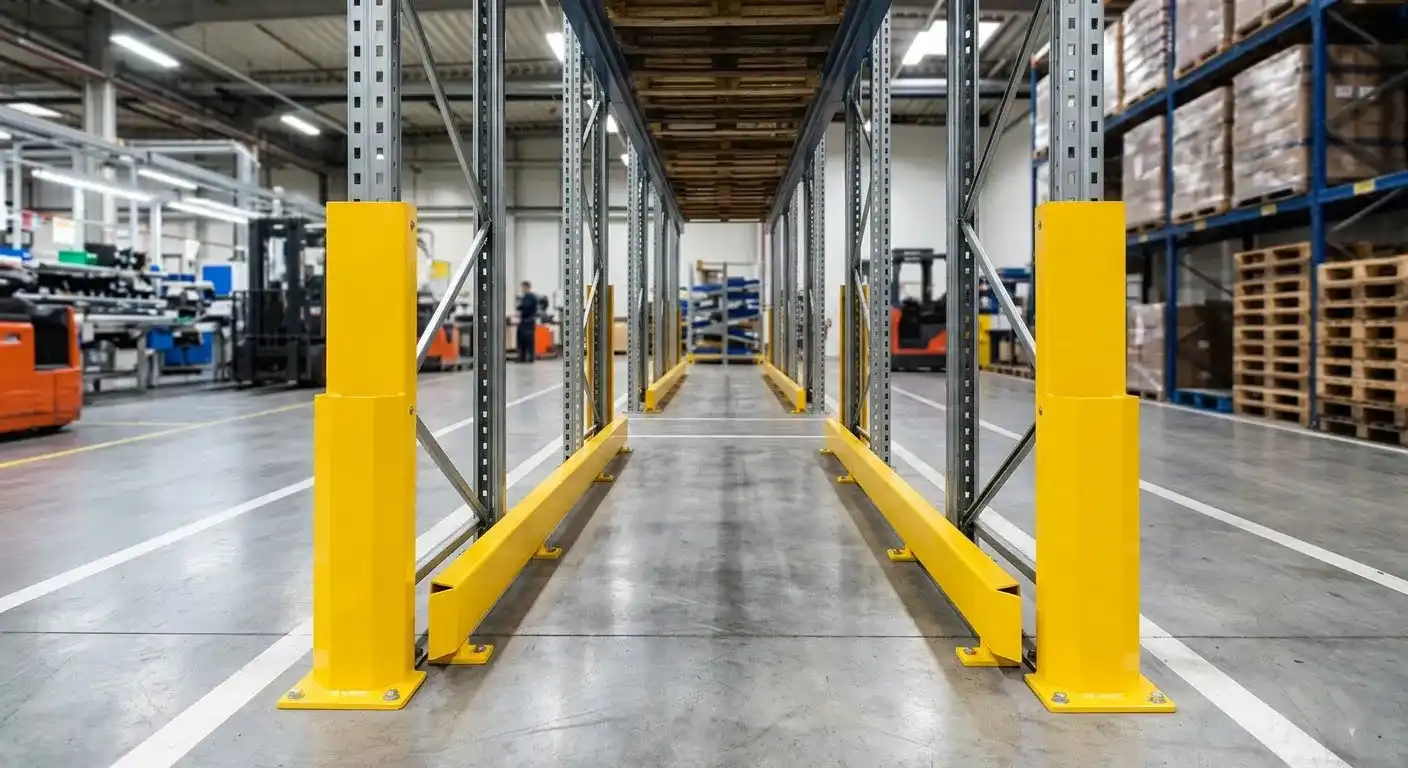
Forklift entry points experience the most contact. Entry guides, rail protectors, and upright guards help reduce damage at these critical areas. In real warehouse operations, these protective accessories often extend rack life and reduce maintenance costs.
Pallet Stops and Lane Control Accessories
Pallet stops help drivers position pallets correctly and reduce overloading at the back of the lane. Depending on your layout, you may also use guide rails, lane markers, and load signage to improve consistency.
Required Forklift Types for Drive-In Racking
The best forklift for drive-in racking depends on how your lanes are designed and how your warehouse operates. There is no single answer for every site, but there are clear technical requirements you should follow.
Why Forklift Compatibility Matters
In standard pallet racking, the forklift usually works from the aisle. In a drive-in system, the forklift enters the lane. That changes everything: maneuvering tolerance is lower, visibility can be reduced, and the risk of rack impact is higher.
If your forklift type does not match your rack design, you may face:
- Frequent upright or rail damage
- Slower cycle times
- Reduced pallet placement accuracy
- Higher maintenance cost
- Increased safety risk
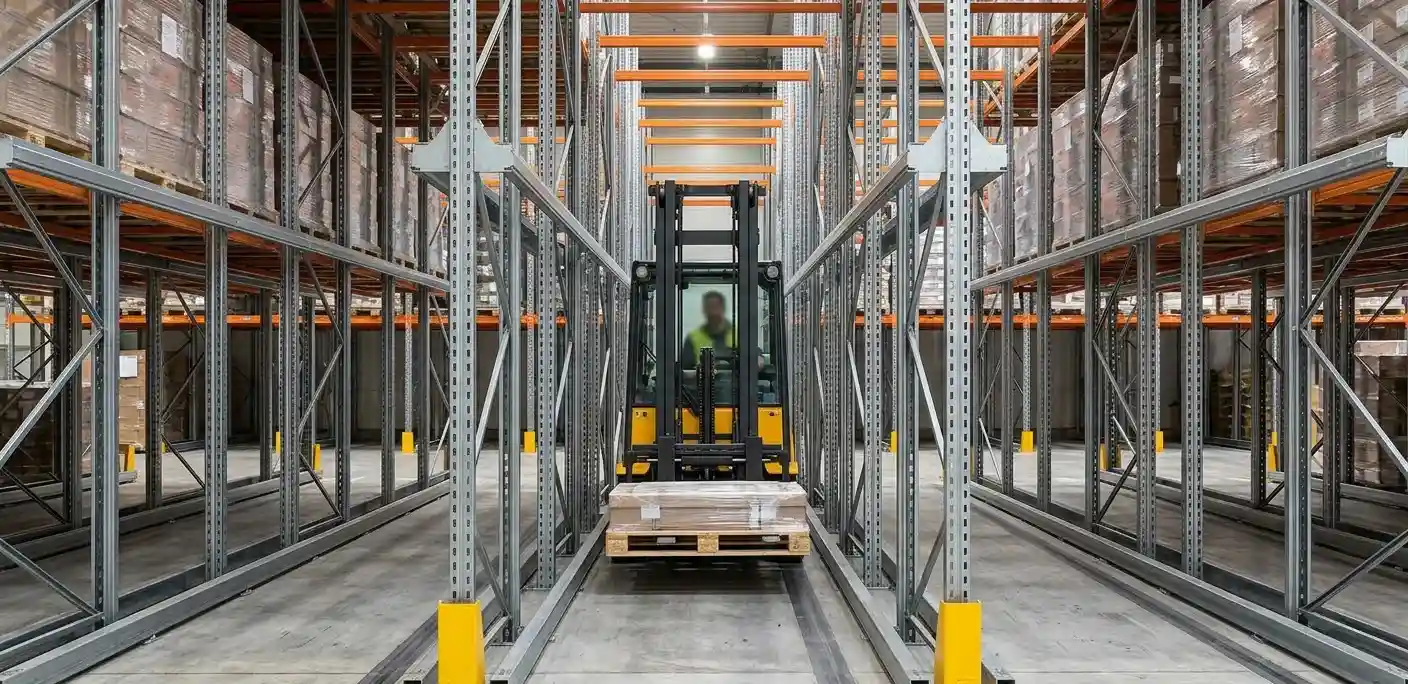
Common Forklift Types Used With Drive-In Racking
| Forklift Type | Suitability for Drive-In Racking | Notes |
|---|---|---|
| Counterbalance forklift | High | Common and practical for many applications |
| Reach truck | Conditional | Depends on lane design and turning clearance |
| Articulated forklift | Conditional | Useful in some layouts, requires evaluation |
| Guided specialized forklift | High in engineered systems | Good for repeatable high-density operations |
Counterbalance Forklifts
In many warehouses, the counterbalance forklift is the most common choice for drive-in racking. It offers solid lifting capacity, direct load handling, and familiarity for operators.
If you use counterbalance forklifts, you need to ensure that:
- Lane width allows safe entry and exit
- Mast height matches the top beam level
- Fork length fits the pallet depth
- Turning clearance is realistic under load
Reach Trucks
A reach truck for drive-in racking may be possible in some engineered layouts, but not in all. Reach trucks are efficient in selective racking environments, yet drive-in lanes create different handling constraints. Before using them, you need to confirm compatibility with lane width, rack geometry, and pallet support configuration.
Specialized Forklifts
In high-throughput or highly standardized operations, some facilities use guided forklifts or narrow-profile machines built for specific lane conditions. These options can improve consistency, though they require more planning and are usually tied to precise warehouse design criteria.
Key Forklift Requirements
Rather than choosing by model alone, you should evaluate the forklift against operating requirements.
| Requirement | Why It Is Important |
|---|---|
| Vehicle width | Must fit the lane safely |
| Lift height | Must reach the highest pallet position |
| Turning stability | Important during lane entry and exit |
| Mast visibility | Helps accurate pallet placement |
| Fork length | Must match pallet dimensions |
| Travel control | Needed for low-speed precision work |
| Floor condition compatibility | Affects vehicle stability and alignment |
If you are planning a new system, forklift selection should be part of the racking design stage, not a later adjustment. This is also where a factory with engineering experience adds value, because rack layout and handling equipment must work as one system.
Safety Considerations for Drive-In Racking Operations
When you operate drive-in racking, safety is not a secondary issue. It is part of the system design. Because forklifts enter the rack structure, the margin for error is smaller than in selective pallet racking.
Operator Training
Drivers need specific instruction for drive-in operations. General forklift certification is necessary, but not always sufficient. Your operators should know:
- How to enter and exit lanes correctly
- How to align pallets with support rails
- How to control speed inside the structure
- How to identify rack damage or misalignment
- How to follow loading sequence rules
Pallet Quality and Load Stability
Poor pallet condition is a major cause of problems in drive-in rack safety. Broken boards, inconsistent pallet sizes, or unstable loads can interfere with rail placement and create dangerous loading situations.
You should inspect pallets for:
- Standardized dimensions
- Adequate strength
- No broken deck boards
- Stable wrapping or load containment
- Even load distribution
If your product types vary significantly, you may need to assess whether drive-in racking is still the best fit.
Rack Impact Prevention
Because forklifts physically enter the storage lane, impact prevention measures are essential. The most common protection methods include upright guards, entry guides, floor-mounted barriers, lane centering aids, and speed control procedures.
The table below shows practical safety controls.
| Risk Area | Common Cause | Recommended Control |
|---|---|---|
| Front upright damage | Forklift turning error | Upright protectors and entry guides |
| Rail impact | Misaligned pallet entry | Driver training and guide systems |
| Overloaded lanes | Poor load control | Load signage and supervision |
| Pallet collapse | Damaged or weak pallets | Pallet inspection procedure |
| Anchor loosening | Repeated vibration or impact | Scheduled inspection and retightening |
| Reduced visibility | Low light or obstructed view | Better lighting and lane marking |
Load Capacity Compliance
Every drive-in racking system should have clearly defined load limits. These include pallet weight, lane depth, bay load, and elevation constraints. Overloading not only increases structural stress but also affects forklift handling.
Capacity must be based on engineered calculations and site-specific configuration.
Inspection and Maintenance
Routine inspections are a core component of safe operation. The inspection content includes:
- Bent uprights
- Rail deformation
- Loose anchors
- Damaged protectors
- Missing components
- Visible misalignment
- Corrosion in demanding environments
A simple inspection schedule helps you prevent minor damage from becoming a larger structural issue.
| Inspection Type | Frequency | Performed By |
|---|---|---|
| Visual operator check | Daily | Forklift operator or shift lead |
| Internal maintenance check | Weekly or monthly | Warehouse maintenance team |
| Formal rack inspection | Periodic, based on site risk | Qualified inspector |
| Post-impact inspection | Immediately after incident | Supervisor and qualified assessor |
Safe Loading and Unloading Procedures
In drive-in lanes, consistency matters. Drivers should place pallets squarely and fully onto the rails. Loads must not be dropped, forced, or pushed into place. Retrieval must follow the operating sequence intended by the layout.
In facilities where stock rotation is critical, you may also want to compare drive-through racking, which allows access from both ends and supports FIFO in some applications.
Advantages and Limitations of Drive-In Racking
Advantages
| Advantage | Operational Benefit |
|---|---|
| High storage density | More pallets in less floor space |
| Fewer aisles required | Better cubic utilization |
| Suitable for repeated SKU storage | Efficient for batch inventory |
| Good fit for cold storage | Maximizes high-cost refrigerated space |
| Lower building expansion pressure | Improves existing footprint usage |
Limitations
| Limitation | Practical Impact |
|---|---|
| Lower selectivity | Not ideal for many different SKUs |
| LIFO storage flow | Not suitable for strict FIFO inventory |
| Higher operator dependence | Requires better forklift discipline |
| Greater impact risk | Needs more protection and inspections |
| Pallet consistency required | Poor pallet quality can cause failures |
This is why drive-in racking is highly effective in the right environment and inefficient in the wrong one.
How to Know If Drive-In Racking Is Right for Your Warehouse
- ✓ You store many pallets of the same product
- ✓ You want high-density storage
- ✓ You can work with LIFO inventory flow
- ✓ Your pallets are uniform in size and condition
- ✓ Your forklift operators are trained for lane entry
- ✓ Your warehouse needs better cube utilization
If your business handles many SKUs with frequent direct access requirements, a more selective storage system may be the better option.
As a racking manufacturer, Spieth usually recommends evaluating five design inputs before confirming a drive-in solution: pallet size, pallet weight, SKU count, throughput frequency, and available forklift type. These factors determine whether the system will perform efficiently over time.
Conclusion
If your goal is to increase pallet density and make better use of your warehouse volume, drive-in racking can be a strong solution.
The key is to treat it as a complete operating system, not just a steel structure. Your rack design, forklift type, pallet quality, and safety procedures all need to support the same workflow.
If you are planning a drive-in pallet racking project, you can contact our team for layout advice, technical support, and a solution matched to your warehouse conditions.
FREQUENTLY ASKED QUESTIONS
What is the difference between drive-in racking and drive-through racking?
Drive-in racking is usually loaded and unloaded from one side, so it follows LIFO. Drive-through racking is accessible from both sides and can support FIFO in suitable layouts.
Is drive-in racking safe?
Yes, drive-in racking is safe when it is properly engineered, correctly installed, and operated by trained forklift drivers using suitable pallets and equipment.
What type of forklift is used for drive-in racking?
A counterbalance forklift is commonly used, but the correct choice depends on lane width, lift height, pallet size, and site layout.
What industries use drive-in racking?
It is widely used in cold storage, food and beverage, manufacturing, frozen goods, and bulk pallet storage operations.
What are the disadvantages of drive-in racking?
The main disadvantages are lower SKU selectivity, LIFO stock rotation, higher risk of rack impact, and stricter pallet quality requirements.
How deep can drive-in racking be?
Lane depth varies by application, pallet type, load, and handling method. The correct depth should always be determined by engineering and operational safety requirements.
Does drive-in racking save space?
Yes. It is designed to reduce aisle space and increase storage density, which helps you store more pallets within the same warehouse footprint.