What Is Pallet Racking?
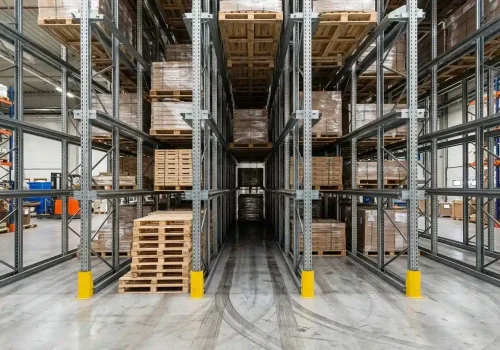
A pallet racking system is the backbone of high-performance industrial storage solutions. Designed to store goods on pallets in horizontal rows across multiple vertical levels, it serves as the structural skeleton of a warehouse.
Whether you are looking for heavy-duty warehouse shelving or a fully automated system, these structures organise inventory into “unit loads” to maximise density. By implementing a custom pallet racking design, businesses can effectively convert a single level of floor storage into multiple accessible tiers, drastically reducing the cost per pallet position.
Whether you’re planning to purchase pallet racking systems for a new facility or upgrade existing warehouse storage, understanding the right configuration is essential for maximizing your investment. This guide covers everything from system types to selecting racking supplier.
Components and How It Works
While pallet racking comes in various configurations, most systems rely on a set of standardized core components to ensure structural integrity and load capacity.
Core Skeleton
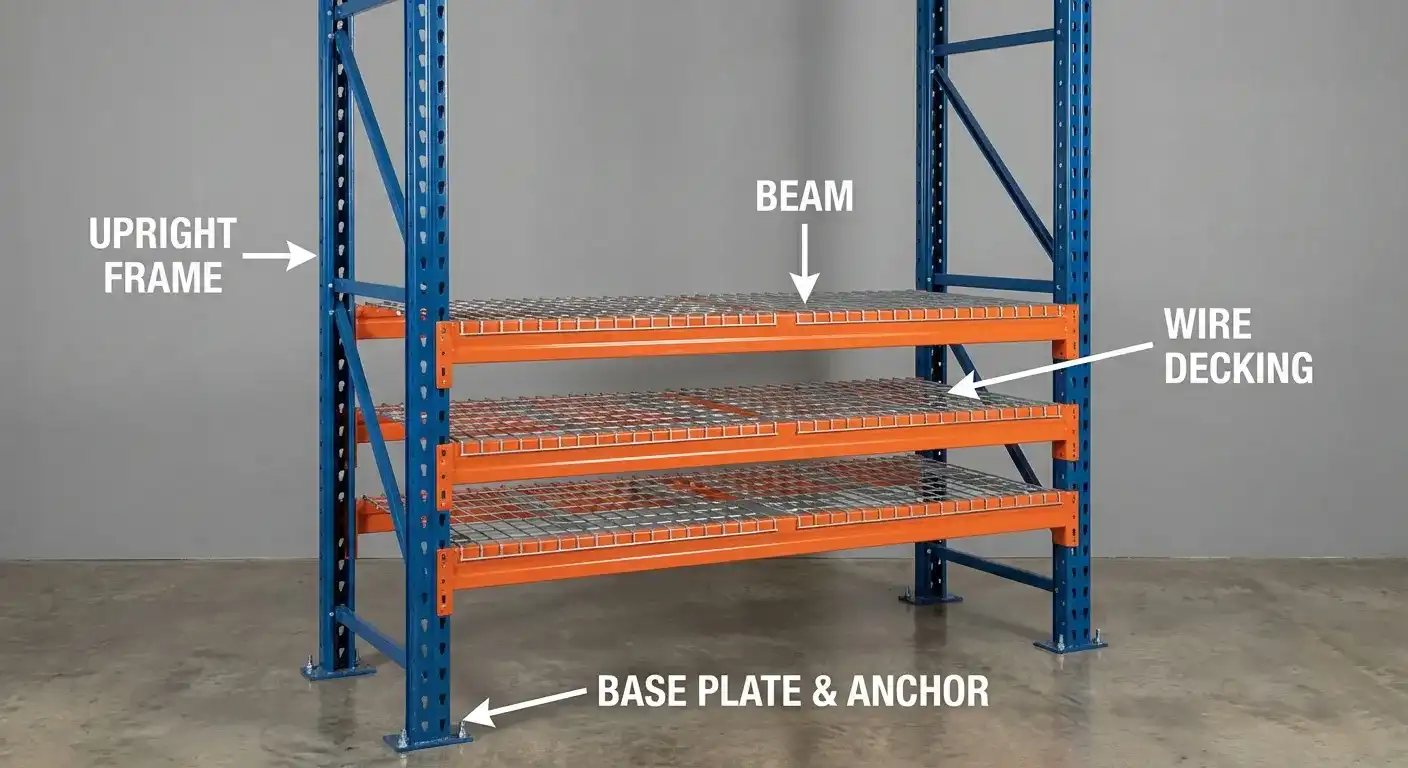
The basic rack structure consists of two main steel parts:
- Uprights (Upright Frames): Vertical steel posts that determine the height and depth of the system. They carry the weight of the stored inventory and transfer it to the floor.
- Beams: Horizontal steel members that connect the upright frames. They provide lateral support and create the actual levels where pallets rest. Typically, two frames and the corresponding beams make up a bay.
Support and Stability
To enhance safety and functionality, additional components are often integrated:
- Wire Decking: Grid panels placed on beams to act as a base for pallets. They prevent loose items from falling and allow water to pass through, ensuring fire sprinkler systems remain effective.
- Anchors: Bolts that secure the uprights to the concrete floor through base plates. This is critical for stability, especially in seismically active zones or during minor forklift impacts.
Why Use Pallet Racking? Key Benefits
Investing in professional warehouse storage optimization is a critical step for businesses scaling logistics. Beyond simple storage, these systems offer measurable ROI by maximising warehouse capacity and workflow speed. Here is why switching to a cost-effective storage system is essential for your bottom line:
1. Optimises Vertical Space
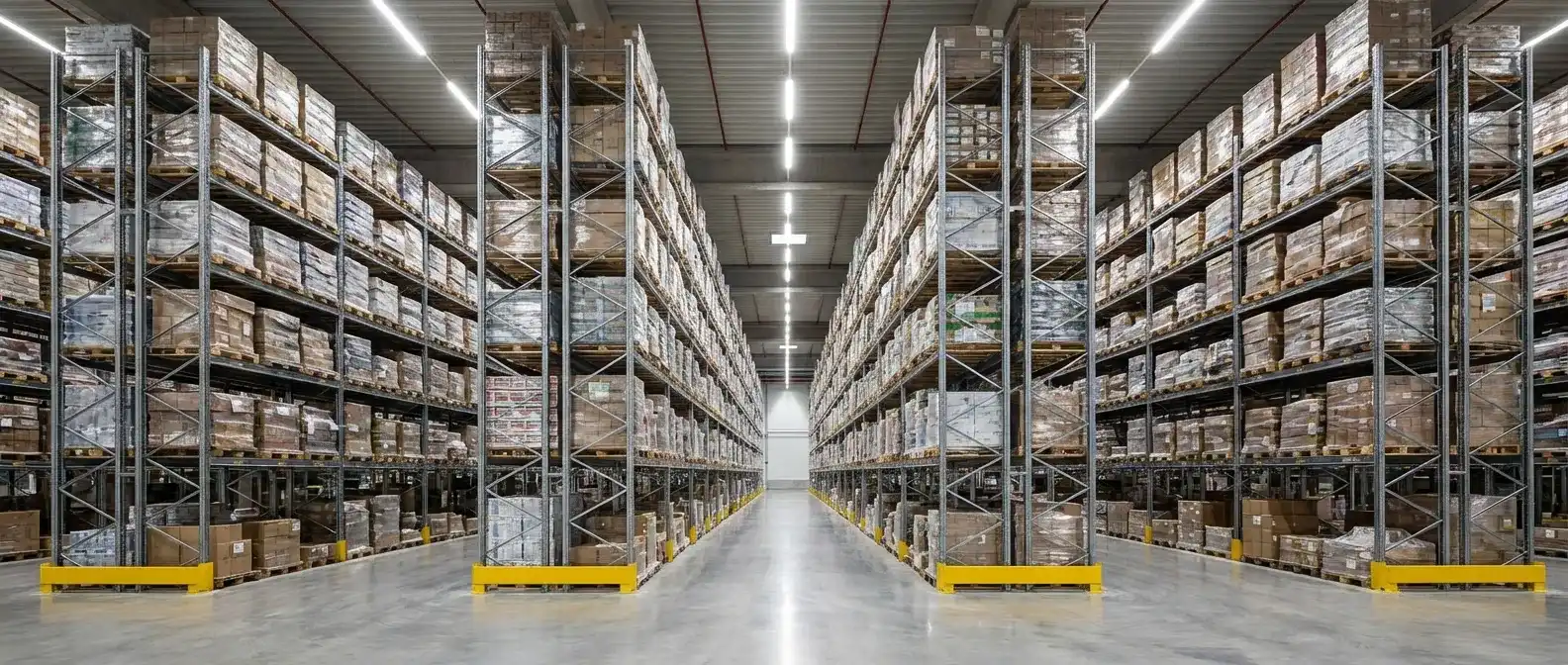
The primary advantage of pallet racking is the ability to capitalise on vertical height. By storing goods in multiple tiers, warehouses can significantly increase their storage capacity—often doubling or tripling density compared to floor stacking—without the capital expense of acquiring additional square footage. This vertical utilisation is essential for facilities operating in areas with high real estate costs per square metre.
2. Enhances Operational Efficiency
Racking systems streamline the picking and packing process by organising inventory into designated, easily accessible slots. This structure reduces the travel time forklift operators spend searching for items, directly improving order fulfilment speeds. An organised warehouse also allows for clearer aisles, enabling material handling equipment to manoeuvre without obstruction.
3. Improves Inventory Management
Effective storage systems support precise stock control strategies, such as FIFO (First-In, First-Out) or LIFO (Last-In, First-Out). By dedicating specific bays to specific products (SKUs), businesses can monitor stock levels more accurately, minimising the risks of overstocking or facing unexpected shortages.
4. Increases Safety and Protects Goods
Floor stacking can be unstable and poses a risk of collapse, endangering staff and damaging inventory. Racking systems secure heavy loads within an engineered steel frame, preventing crushing damage to goods at the bottom of the stack. Furthermore, elevating inventory clears floor space, removing trip hazards and reducing the likelihood of workplace accidents.
5. Cost-Effective Warehouse Expansion
Investing in pallet racking installation is significantly more economical than leasing additional warehouse space. For businesses evaluating warehouse storage solutions, the ROI typically manifests within 18-24 months through increased capacity and improved labour efficiency. When working with experienced industrial racking suppliers, you can customize systems to your exact specifications, ensuring every square metre delivers value.
Types of Pallet Racking Systems?
Below is a comparison of common pallet racking types and their key features:
| Racking Type | Core Features | Inventory Flow | Best Use Case |
|---|---|---|---|
| Selective Racking | Provides 100% direct access to every pallet without moving others. | Any Access | Warehouses with many SKUs, high turnover, and need for immediate access. |
| Drive-In Racking | Forklifts drive directly into the rack; eliminates aisles for max density. | Last-In, First-Out (LIFO) | Storing large quantities of homogeneous products; expensive cold storage. |
| Push Back Racking | Pallets sit on wheeled carts; new pallets push old ones back (2-6 deep). | Last-In, First-Out (LIFO) | Medium-density storage needing better selectivity than Drive-In. |
| Pallet Flow | Uses gravity roller tracks; pallets load at one end and glide to the other. | First-In, First-Out (FIFO) | Perishable goods (food, beverage) or inventory with expiration dates. |
| Cantilever Racking | Uses arms extending from a column; no front column obstruction. | Any Access | Storing long, irregular items like lumber, pipes, or metal sheets. |
1. General and High Accessibility
Selective Pallet Racking
This is the most common and lowest-cost system. Its core advantage is offering 100% selectivity, meaning operators can access any pallet directly without moving others. This makes it ideal for warehouses with a high diversity of products (SKUs). The system is simple to install and highly adjustable.
Double Deep Racking
This configuration places one row of selective racking behind another, creating a storage depth of two pallets. While this increases storage density, it sacrifices direct accessibility (reduced selectivity) and requires specialized forklifts with telescopic forks to operate.
2. High-Density Storage (LIFO/FIFO)
Drive-In and Drive-Thru Racking
Designed to maximize space utilization by eliminating aisles, allowing forklifts to drive directly into the rack structure to access pallets.
- Drive-In: Follows a “Last-In, First-Out” (LIFO) principle with only one entry/exit point.
- Drive-Thru: Open at both ends, allowing for “First-In, First-Out” (FIFO).
Both systems are ideal for storing large amounts of the same product.

Push Back Racking
Utilizes a system of wheeled carts on rails. When a new pallet is loaded, it pushes the previous one back (LIFO). This system allows for storage 2 to 6 pallets deep on each side of the aisle, offering better selectivity than Drive-In while maintaining high density.
Pallet Flow Racking (Live Storage)
Uses gravity rollers and inclined tracks. Pallets are loaded at the high end and glide via gravity to the lower end for retrieval. This is a strict “First-In, First-Out” (FIFO) system, making it ideal for perishable goods or high-turnover inventory.
3.Specialty Racking
Cantilever Racking
Not all inventory fits on standard pallets. Cantilever systems use arms extending from columns rather than shelves, specifically designed to store long, bulky items like lumber, pipes, or metal sheets.
Mobile Racking
Racks are mounted on mobile bases that run on tracks in the floor. The system opens the required aisle by moving the rack sections electronically, eliminating the wasted space of fixed aisles.
How to Choose the Right System
Selecting a pallet racking solution is not a one-size-fits-all decision. It requires a strategic assessment of your current inventory needs, facility constraints, and future growth projections. Engineers and logistics managers typically evaluate the following four critical factors before installation.
1. Product Characteristics
The physical nature of your stock is the primary driver for system selection.
-
Perishability: Goods with expiration dates (food, pharmaceuticals) require FIFO systems like Pallet Flow to prevent spoilage. Durable goods can utilise LIFO methods like Drive-In racking.
-
SKU Profile: Analyse your stock diversity. If you manage thousands of unique SKUs with low volume per item, Selective Racking is necessary for accessibility. Conversely, if you store massive quantities of the same SKU, high-density options are more efficient.
2. Warehouse Layout and Structure
Your physical facility imposes hard limits on design.
-
Verticality: Measure the clear height from the floor to the lowest ceiling obstruction (such as sprinklers or lighting). High-bay systems utilise this space but may require flatter floors (Superflat) to ensure stability at height.
-
Floor Capacity: The concrete slab must be rated to support the point loads exerted by the racking uprights.
-
Obstacles: Column grids and door locations will dictate the orientation of your aisles.
3. Material Handling Equipment (MHE)
Racking systems must be compatible with your forklift fleet.
-
Counterbalance Trucks: These require standard aisle widths (typically 3.5 to 4 metres) to turn safely.
-
Reach Trucks: These can operate in narrower aisles (roughly 2.7 metres), allowing for tighter racking configurations.
-
VNA Trucks: Specialised guidance vehicles can operate in aisles as narrow as 1.6 metres, maximising floor usage but requiring significant upfront investment in equipment.
4. Budget and Scalability
Pallet racking costs vary significantly based on system complexity, ranging from £50-£150 per pallet position for selective racking to £200+ for automated high-density systems. When requesting pallet racking quotes, consider:
- Installation labour costs (typically 15-25% of equipment cost)
- Warehouse racking installation services including anchoring and safety compliance
- Ongoing maintenance contracts
- System reconfiguration flexibility as your inventory profile evolves
Safety, Maintenance & Accessories
A pallet racking system is a significant structural installation that holds tonnes of potential energy above the heads of your workforce. Ensuring its integrity is not just a matter of protecting inventory, but a critical legal and ethical obligation to ensure workplace safety.
1. Regular Inspections
Racking is not a “set and forget” asset. It requires a rigorous inspection programme to identify structural weaknesses before they lead to failure. In the UK, it is industry standard to have systems reviewed annually by SEMA (Storage Equipment Manufacturers’ Association) Approved Rack Inspectors. Additionally, staff should be trained to perform weekly visual checks, reporting any beam deflection, twisted uprights, or missing safety pins immediately.

2. Protective Accessories
Given the busy nature of warehouse environments, accidental forklift impacts are common. Installing protective gear can drastically extend the lifespan of your racking:
-
Column Guards: Steel or plastic shields bolted to the floor in front of uprights to absorb impact from forklifts.
-
Anti-Collapse Mesh: Fixed to the rear of racking runs to prevent loose items from falling into walkways or working areas.
-
End-of-Aisle Barriers: Heavy-duty steel rails that protect the vulnerable corners of racking rows from turning vehicles.
3. Adhering to Load Limits
Every racking system is engineered with a specific Safe Working Load (SWL). These limits must be clearly displayed on load notice signs (often called load plaques) at the end of each aisle. Operators must strictly adhere to these weight restrictions, as overloading beams can cause permanent deformation or catastrophic collapse.
Conclusion
Pallet racking is the cornerstone of efficient warehousing and logistics. Whether you need the high accessibility of selective racking or the high-density storage of drive-in racking, partnering with Spieth pallet racking ensures optimal space utilization and long-term reliability.
Ready to optimize your warehouse? Looking for a reliable pallet racking solution? Contact Spieth pallet racking experts for a free consultation and custom design. By matching your system to your product flow, budget constraints, and growth projections, you’ll implement a storage solution that delivers measurable ROI and supports sustainable business expansion.